

Unlike conventional manufacturing model, Industry 4.0 is de-centralized with communication between sensors, equipment, material and the factory. This model results in increased business agility, lower production cost, better quality and efficiency. Using the Industrial Internet of Things (IIoT), products has the capability to communicate with equipment and decisions related to routing, changing priority, adding additional inspection steps, etc. can be made quickly without any human intervention.
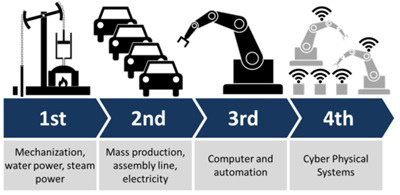
Industry 4.0 establishes both vertical and horizontal integration of manufacturing systems. Vertical integration requires collection and integration of data from equipment sensors, components and other sub-systems to the equipment data to the data from other equipment and factory data. Horizontal integration requires integration across the factory and the entire supply-chain, including partners, suppliers and sub-contractors
eInnoSys offers products and solutions to make your equipment Industry 4.0 ready.
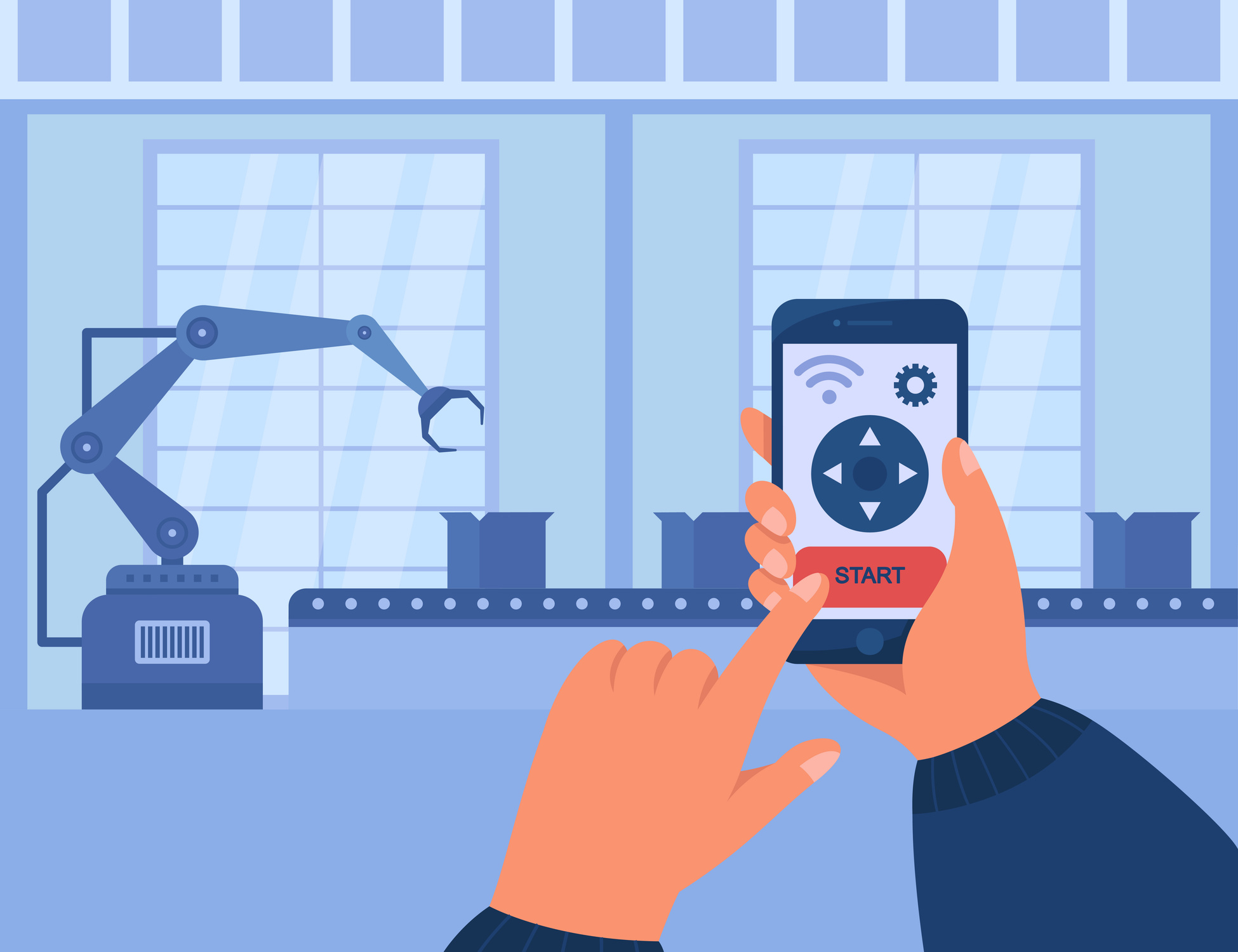
Our product EIMobileMonitor allows monitoring critical equipment parameters from the equipment’s components on an engineer’s mobile device, even if the equipment doesn’t support SECS/GEM standards.
eInnoSys is one of the handfuls of companies that have successfully developed the entire controller software with SECS/GEM on Android platform, which is quite challenging.
Industry 4.0 & Smart Factory Solutions
Transform manufacturing with connected systems, real-time data, industrial automation, and AI-driven decision-making.
Industry 4.0 is changing how modern factories operate. It connects machines, software, sensors, engineers, and production data into one intelligent ecosystem. At eInnoSys, we help manufacturers move from conventional operations to smart factory environments using industrial connectivity, SECS/GEM integration, predictive maintenance, factory automation software, AI/ML analytics, and real-time monitoring solutions.
Whether you are exploring what Industry 4.0 is, planning a digital transformation roadmap, or looking for practical smart manufacturing solutions, our team helps you build scalable, production-ready systems for the future.
What is Industry 4.0?
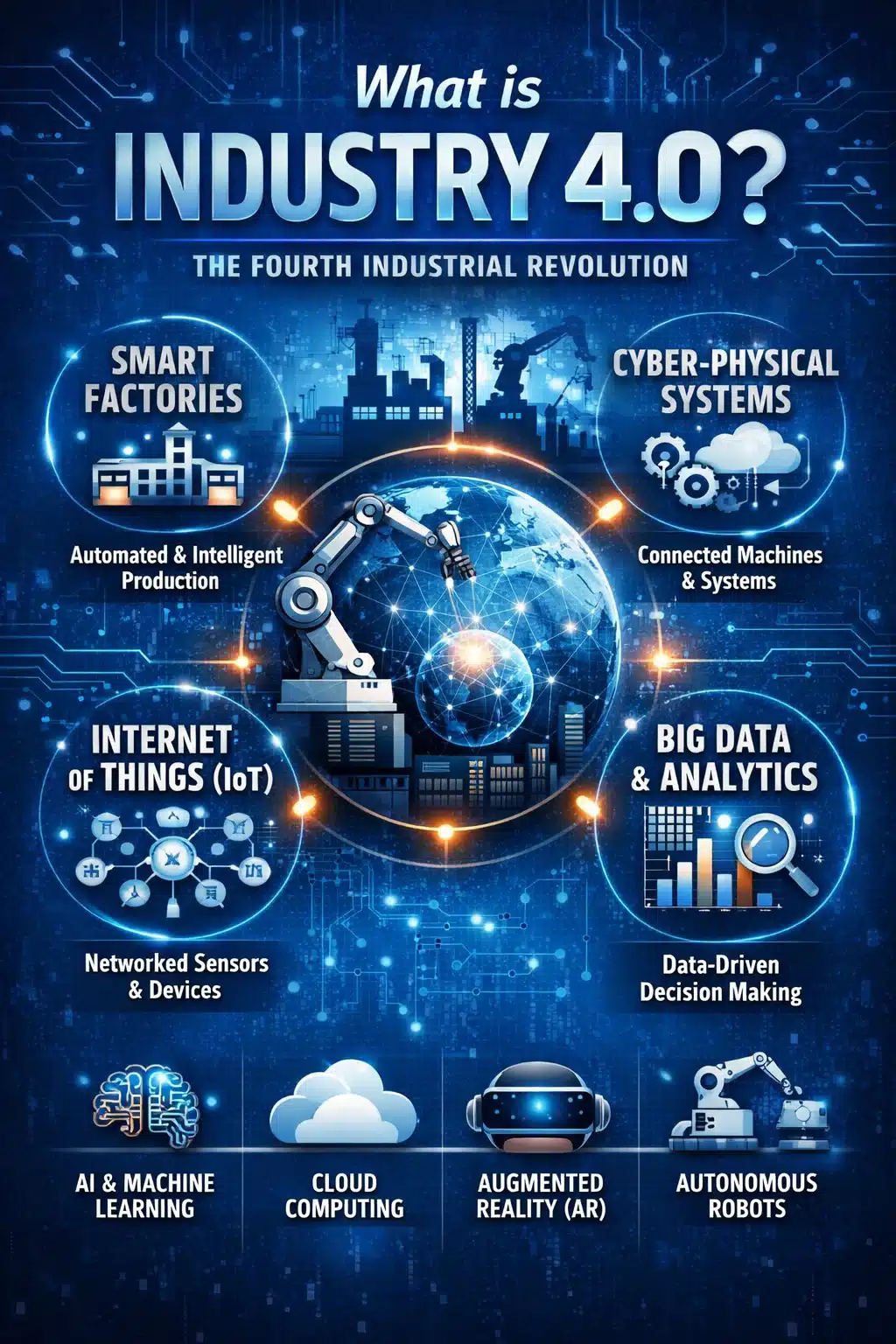
Industry 4.0 refers to the fourth major phase of industrial development, where manufacturing systems become more intelligent, connected, automated, and data-driven.
The industry 4.0 mean is simple: factories no longer operate as isolated systems. Instead, equipment, sensors, software platforms, operators, and business systems work together in real time. This creates a more responsive, efficient, and transparent production environment.
Industry 4.0 combines technologies such as:
- Industrial Internet of Things (IIoT)
- Artificial Intelligence (AI)
- Machine Learning (ML)
- Cloud and edge computing
- Real-time monitoring
- Advanced analytics
- Industrial automation
- Cyber-physical systems
- Smart equipment communication
In practical terms, Industry 4.0 in manufacturing means faster decisions, lower downtime, improved quality, and better control across the factory floor.
Industry 4.0 Mean: Why It Matters to Modern Manufacturing
If someone asks, “Industry 4.0 means what for a real factory?”, the answer is this:
It means production is no longer based only on manual oversight and disconnected tools. Instead, machines generate usable data, systems communicate automatically, issues are detected earlier, and actions can be taken faster.
This matters because manufacturers today face constant pressure to:
- Reduce downtime
- Improve throughput
- Increase OEE
- Lower maintenance cost
- Improve traceability
- Integrate legacy and modern equipment
- Respond faster to quality issues
- Scale automation without disrupting production
Industry 4.0 helps solve these challenges by turning raw operational data into actionable intelligence.
Industrial Revolution 4.0: From Traditional Manufacturing to Smart Manufacturing
The term Industrial Revolution 4.0 describes the next major evolution in industry after mechanization, electrification, and digital automation.
The Four Industrial Revolutions
1st Industrial Revolution
Mechanization through water and steam power.
2nd Industrial Revolution
Mass production enabled by electricity and assembly lines.
3rd Industrial Revolution
Digital automation using electronics, PLCs, and computer systems.
4th Industrial Revolution
Connected, intelligent, and automated systems powered by data, software, IIoT, AI, and real-time communication.
The difference with Industrial Revolution 4.0 is that the factory is not just automated. It is connected, intelligent, and capable of adapting based on live conditions.
What Makes a Smart Factory?
A smart factory is a manufacturing environment where machines, equipment software, plant systems, and analytics platforms work together to improve visibility, automation, and decision-making.
In a smart factory:
- Machines share data in real time
- Equipment health can be monitored continuously
- Maintenance can shift from reactive to predictive
- Production events can trigger automated responses
- Operators get better visibility into process performance
- Management gains actionable dashboards and reports
A smart factory is not just about adding sensors. It is about connecting machines, software, and workflows into a system that improves operational outcomes.
Core Technologies Behind Industry 4.0
IIoT and Connected Equipment
Industrial Internet of Things connects assets, sensors, controllers, and equipment for real-time monitoring and data collection.
AI and Machine Learning
AI/ML helps identify patterns, predict failures, detect anomalies, and support better maintenance and process decisions.
Cyber-Physical Systems
These systems connect physical equipment with digital intelligence, allowing factory processes to be monitored and optimized continuously.
Cloud and Edge Computing
Cloud platforms support centralized visibility, while edge systems allow fast local processing for time-sensitive factory operations.
Industrial Communication and Integration
Standards and protocols such as SECS/GEM, GEM300, PLC/HMI integration, and subsystem connectivity are essential to make Industry 4.0 practical in real manufacturing environments.
Industry 4.0 in Manufacturing: Real Business Benefits
Manufacturers adopt Industry 4.0 solutions because the business impact is measurable.
1. Reduced Downtime
Connected monitoring and predictive analytics help detect abnormal behavior before it leads to equipment failure.
2. Improved OEE
Better visibility into equipment performance helps teams improve availability, performance, and quality.
3. Faster Decision-Making
Real-time dashboards and equipment events allow teams to respond quickly to issues.
4. Better Quality Control
Data-driven processes make it easier to identify variation, track defects, and improve process consistency.
5. Lower Maintenance Costs
Predictive maintenance reduces unnecessary servicing and helps prevent expensive breakdowns.
6. Better Integration Across Systems
Industry 4.0 enables stronger vertical and horizontal integration across equipment, MES, SCADA, engineering tools, and enterprise systems.
What Is Industry 4.0 and 5.0?
Many manufacturers now ask: what is industry 4.0 and 5.0?
Industry 4.0
Industry 4.0 focuses on automation, connectivity, data exchange, and intelligent manufacturing systems.
Industry 5.0
Industry 5.0 builds on Industry 4.0 by adding more emphasis on:
- Human-machine collaboration
- Resilience
- Sustainability
- Personalization
- People-centered innovation
In short:
Industry 4.0 is about connected and intelligent factories
Industry 5.0 is about making those factories more human-centric, adaptable, and sustainable
For many manufacturers, Industry 5.0 does not replace Industry 4.0. It extends it.
Common Challenges in Industry 4.0 Adoption
Digital transformation sounds exciting, but implementation can be complex. Common challenges include:
Legacy Equipment Integration
Older machines often lack modern communication capability. These assets still need to be connected to support smart factory goals.
Data Silos
Equipment data, maintenance data, process data, and management systems often remain disconnected.
Limited Real-Time Visibility
Without centralized monitoring, teams struggle to act quickly.
Unplanned Downtime
Reactive maintenance creates risk, cost, and production loss.
Scalability Issues
Some solutions work for one machine but fail when applied across lines, tools, or sites.
This is where practical engineering and domain-specific manufacturing software become critical.
How eInnoSys Supports Industry 4.0 Transformation
At eInnoSys, we help equipment makers and manufacturers implement practical Industry 4.0 smart factory solutions that improve operations without overcomplicating deployment.
Our capabilities include:
SECS/GEM and GEM300 Integration
We develop and support SECS/GEM and GEM300 solutions that enable factory connectivity, equipment communication, and integration readiness for semiconductor and advanced manufacturing environments.
Predictive Maintenance Solutions
Our AI/ML-driven monitoring systems help identify early signs of failure in pumps, motors, exhaust systems, ovens, furnaces, and other critical assets.
Smart Monitoring and Analytics
We build solutions for equipment monitoring, anomaly detection, event tracking, and operational dashboards.
Legacy Equipment Modernization
We help older equipment become smart factory-ready through integration frameworks and communication-enabling solutions.
Factory Automation Software
Our software solutions support higher visibility, stronger traceability, automated workflows, and better production control.
The current page already highlights that eInnoSys offers Industry 4.0-ready products, mobile monitoring, smart factory support, and related equipment software services.
Industries and Use Cases
Our Industry 4.0 solutions are especially valuable for:
- Semiconductor manufacturing
- Electronics manufacturing
- Equipment OEMs
- Assembly and test operations
- Automated production environments
- Legacy-to-smart-factory modernization projects
Typical use cases include:
- Equipment Communication Enablement
- Predictive Maintenance
- Remote equipment monitoring
- Smart alarms and notifications
- Real-time production visibility
- Factory integration readiness
- Data-driven maintenance strategy
Why Choose eInnoSys for Smart Factory Implementation?
eInnoSys combines industrial software expertise with real-world factory integration experience. We understand the gap between concept and implementation.
Our approach focuses on:
- Practical Deployment
- Scalable Architecture
- Equipment-Level Integration
- Factory Communication Standards
- Data-driven Visibility
- Measurable ROI
We do not treat Industry 4.0 as a buzzword. We treat it as a structured path to better manufacturing performance.
Related Equipment Software Services
For more information and pricing
Frequently Asked Questions
What is Industry 4.0 in simple words?
Industry 4.0 is the use of smart, connected, and data-driven technologies in manufacturing to improve efficiency, automation, and decision-making.
What does Industry 4.0 mean for factories?
It means machines, software, and systems can communicate in real time, helping factories reduce downtime, improve quality, and increase productivity.
What is the difference between Industry 4.0 and smart factory?
Industry 4.0 is the broader concept. A smart factory is one practical result of Industry 4.0 implementation.
What is Industry 4.0 and 5.0?
Industry 4.0 focuses on automation and connectivity. Industry 5.0 adds human collaboration, sustainability, and resilience.
Is Industry 4.0 only for large manufacturers?
No. Industry 4.0 can start with one machine, one production line, or one use case such as predictive maintenance or equipment integration.