

What is SECS/GEM?
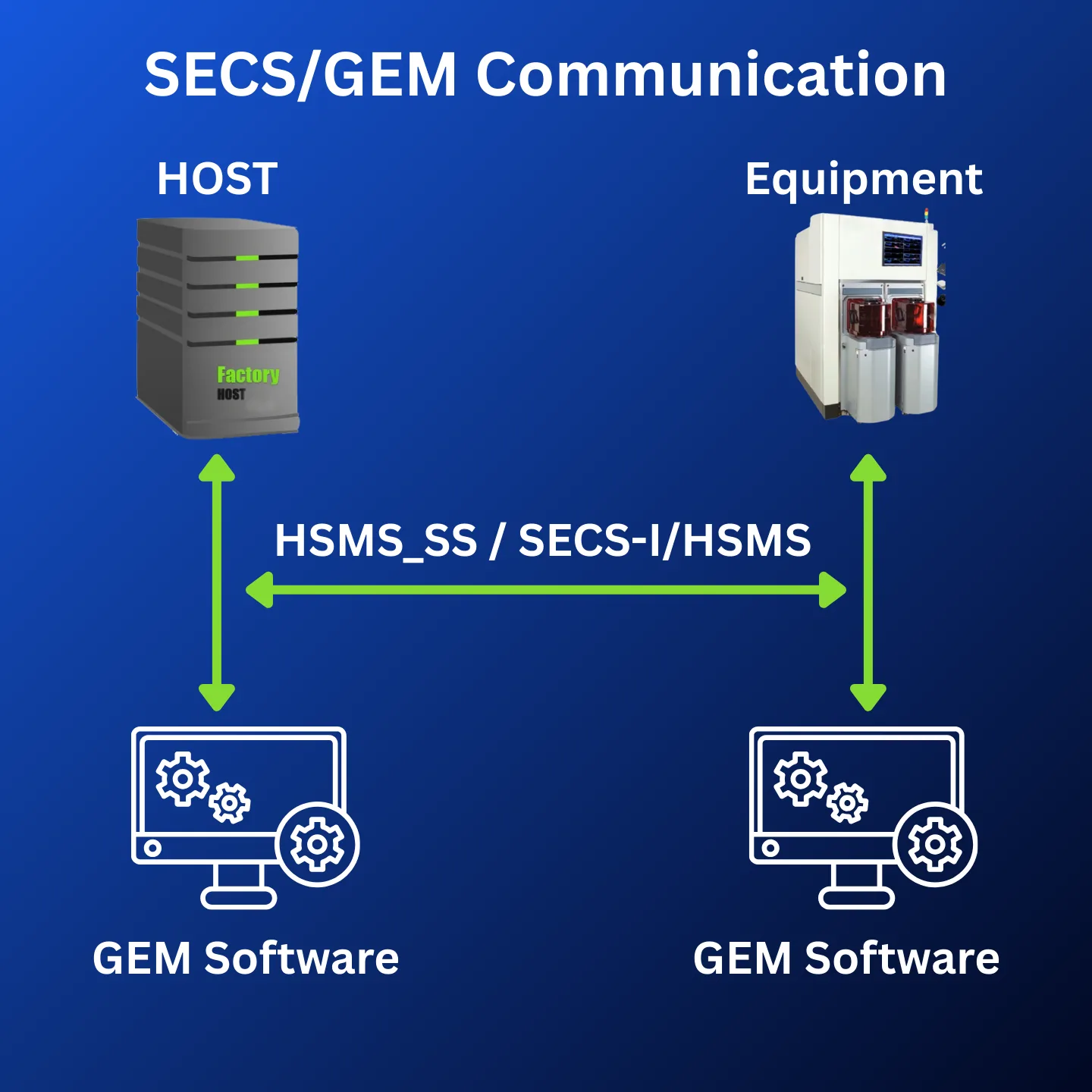
SECS (SEMI Equipment Communications Standard)/GEM (Generic Equipment Model) is communication interface protocols for communication between semiconductor equipment and a fab host. Fab host is a software application that is controlling and monitors equipment processing using SECS/GEM protocol.
SECS/GEM compliant equipment can communicate with the fab host using either TCP/IP (using SEMI standards E37 and E37.1 – HSMS) or RS-232 (using SEMI standard E4 – SECS-I). The SECS/GEM standard interface is used to start as well as stop equipment processing, collect measurement data, select recipes for products, and change variables. With SECS/GEM, all this can be performed in a standard way.
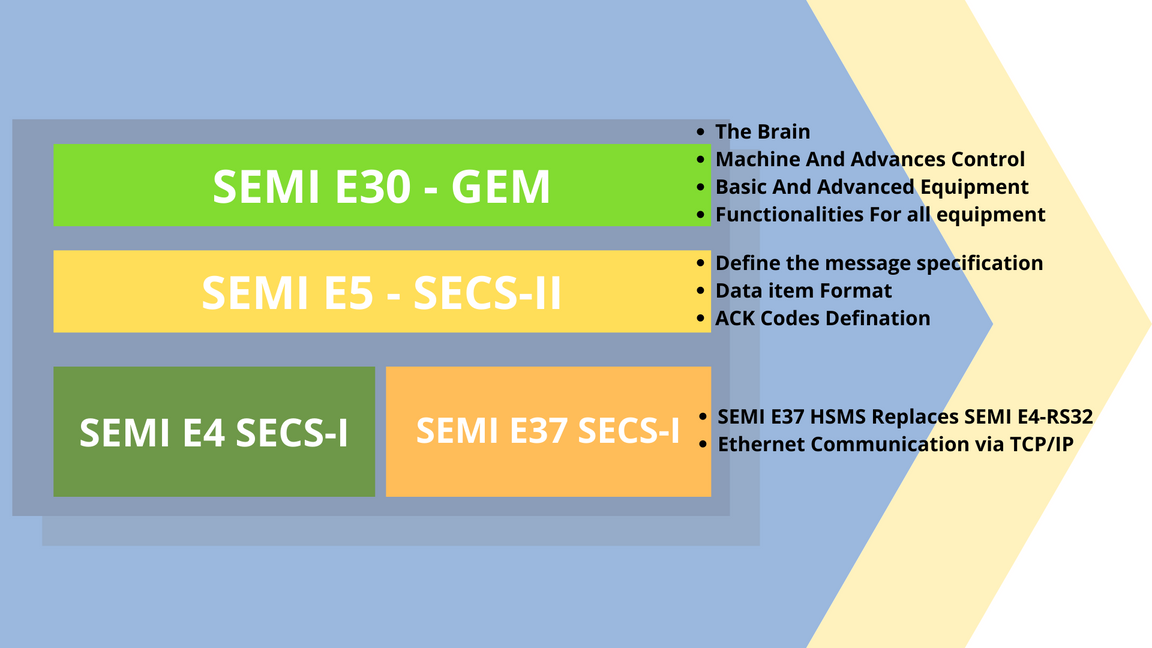
SECS/GEM protocol has been standardized by the non-profit association SEMI (Semiconductor Equipment and Materials International). semi.org to learn more about SEMI standards and SECS/GEM protocol. This tutorial is aimed at providing an introduction or overview of the SECS/GEM basics to an entry-level or intermediate person in the semiconductor manufacturing industry only.
The detailed SEMI standards it contains are not meant to replace all other comprehensive works. For complete standards, please refer to SEMI. Even though this guide breaks down the ideas, creation of a SECS/GEM driver from scratch is difficult and expensive. It’s crucial to cut costs while enhancing productivity because other things in life have to go on at the same time.


Key Components of SECS/GEM:
SECS (SEMI Equipment Communication Standard):
- Defines the protocols and message formats for communication between host systems and equipment.
- Includes SECS-I (RS-232 based) and HSMS (High-Speed SECS Message Services, TCP/IP based).
GEM (Generic Equipment Model):
- Provides a standard way to control and monitor semiconductor manufacturing equipment.
- Defines a model for equipment behavior, status reporting, and data collection.
Applications of SECS/GEM:
Semiconductor Manufacturing:
- Widely used in the semiconductor industry for wafer fabrication, testing, and packaging.
- Ensures precise control and monitoring of complex manufacturing processes.
Electronics Manufacturing:
- Applied in the production of electronic components and assemblies.
- Enhances the integration and automation of assembly lines.
Pharmaceutical and Biotech Industries:
- Used for equipment communication and control in the production of pharmaceuticals and biotechnology products.
- Ensures compliance with regulatory standards and quality control.
SECS/GEM Communication Diagram:
Patented Plug & Play SECS/GEM Solution for Legacy Equipment
Modernize your legacy semiconductor equipment with zero disruption. Our patented SECS/GEM solution enables fast integration and reliable communication with fab systems.
Successfully implemented on 80+ equipments
Explore Plug & Play SolutionFast deployment. Proven performance. Trusted by fabs.
SECS/GEM Communication Standards
SECS/GEM isn’t just one rule. Not even close. It’s more like a family of SEMI standards working together. Each one handles a different piece of the conversation between semiconductor equipment and factory systems.
Inside a semiconductor fab, machines constantly exchange information. Status updates. Process data. Alarms. Commands. It’s a lot happening at once. The SECS/GEM framework keeps that communication structured so equipment and host systems understand each other.
Different standards handle different layers of this communication stack. Transport. Message structure. Equipment behavior. Put them together and suddenly equipment from completely different vendors can still work together. Pretty impressive, actually.
Let’s walk through the core pieces.
SECS-I (SEMI E4)
SECS-I is one of the original communication methods used in semiconductor manufacturing. Old school, you could say. It defines how equipment and host systems communicate over serial connections, usually RS-232.
Back in the early days of semiconductor fabs, Ethernet networks were not common. Equipment connected directly to host computers using serial cables. SECS-I standardized how data should move across those connections.
The protocol defines several important things:
- Message block structure
- Transmission timing rules
- Handshake procedures
- Error detection mechanisms
Messages are transmitted in blocks, and each block includes header information, the actual data payload, and error checking bits. The host system acknowledges receipt before the next block is sent. Slow, but reliable.
Bandwidth is limited though. Serial communication isn’t exactly fast. But reliability mattered more than speed when the standard was first introduced.
Interestingly, some semiconductor fabs still operate legacy equipment that relies on SECS-I communication. Those tools might be decades old. Still producing wafers though. Still talking through serial ports.
In modern fabs, these older tools are often connected through SECS-I to HSMS gateways, allowing them to communicate with newer factory automation systems. Not elegant maybe, but it works.
HSMS (SEMI E37)
Then came HSMS. Things started to move faster.
HSMS stands for High-Speed SECS Message Services, defined in SEMI E37. Instead of serial connections, HSMS uses TCP/IP Ethernet networks for communication between equipment and host systems.
This was a big shift. Ethernet networks provided higher bandwidth, lower latency, and much better scalability.
HSMS was designed to overcome several limitations of SECS-I:
- Low communication speed
- Limited scalability
- Hardware connection constraints
- Lack of modern networking support
With HSMS, equipment can exchange messages with host systems over standard factory networks. Much faster. Much more flexible.
HSMS communication introduces the concept of session management. Equipment and host systems establish a connection session before exchanging messages.
The protocol defines connection states such as:
- NOT CONNECTED
- CONNECTED
- SELECTED
Once the connection reaches the SELECTED state, normal SECS message exchange begins.
HSMS also supports two communication roles.
- Active mode – equipment initiates the connection
- Passive mode – host initiates the connection
This flexibility allows factories to design different network architectures depending on their automation infrastructure.
Today, most modern semiconductor manufacturing equipment uses HSMS communication instead of SECS-I. Ethernet is simply easier to manage at scale. And faster too.
GEM (SEMI E30)
Transport protocols move messages around. But something still needs to define how equipment behaves during communication. That’s where GEM comes in.
GEM, or Generic Equipment Model, is defined in SEMI E30. It provides a standard equipment communication model that factory systems can interact with.
Think of GEM as the rules that define how equipment should behave once the connection exists.
One important part of GEM is the equipment state model. Equipment can operate in different communication states such as:
- OFFLINE
- ONLINE LOCAL
- ONLINE REMOTE
When equipment is ONLINE REMOTE, the factory host system can send commands and control operations. When it’s in ONLINE LOCAL, operators maintain direct control at the equipment interface.
GEM also defines event reporting. Equipment generates events whenever specific conditions occur, including:
- Process start
- Process completion
- Material load events
- Alarm conditions
Factory systems subscribe to these events and receive notifications as they happen.
Then there’s data collection. Equipment variables can be reported to host systems for monitoring and analysis.
GEM also standardizes alarm management and remote command execution. Host systems can send commands such as:
- Start process
- Stop process
- Select recipe
- Reset alarms
This enables centralized factory automation where systems coordinate equipment operations automatically.
SEMI E5 (SECS-II Message Structure)
Messages still need structure. Otherwise systems wouldn’t know how to interpret incoming data.
That’s the role of SEMI E5, which defines the SECS-II message format used for communication between equipment and host systems.
Every SECS message follows a structured format built around Stream and Function identifiers. Messages are labeled as SxFy.
- Stream (S) represents the message category
- Function (F) represents the specific operation
Examples include:
- S1F1 — Equipment status request
- S1F2 — Equipment status response
- S5F1 — Alarm notification
- S6F11 — Event report
Each message also contains structured data elements such as integers, ASCII text, floating-point values, binary data, or nested lists.
These elements are organized in hierarchical structures so complex information can be transmitted clearly.
Because the message structure is standardized, equipment and host systems from different vendors can interpret messages consistently.
How These Standards Work Together
Now step back for a moment.
Each of these standards handles a different layer of the communication process.
- Transport: SECS-I or HSMS
- Message Structure: SECS-II (E5)
- Equipment Behavior: GEM (E30)
Together, they form the complete SECS/GEM communication architecture used in semiconductor manufacturing.
Once implemented, semiconductor equipment can exchange information with factory automation systems in a standardized way. Process data. Equipment status. Alarm events. Control commands.
Factories gain real-time visibility into production. Automation systems coordinate equipment operations. Engineers monitor performance across manufacturing lines.
Hundreds of machines across a fab stay connected. Talking. Reporting. Responding.
Not glamorous, maybe. But essential for modern semiconductor manufacturing.
SECS/GEM SDK Solutions for 100mm, 150mm & 200mm Wafer Equipment
Enable seamless equipment integration with our advanced SECS/GEM SDK. Designed for legacy and modern wafer equipment, ensuring reliable communication, faster deployment, and full compliance.
Explore SECS/GEM SolutionCompatible with 100mm, 150mm & 200mm semiconductor equipment
How do our SECS/GEM standard services help?
Communication defines the behavior of the equipment regarding the presence or absence of a communication link with the host. It also specifies how to establish or resume communication with S1F13/S1F14 when it is cut off. Using our SECS/GEM Software, the host can have an easy communication process.
EInnosys CONTROL state model in SECS/GEM protocol specifies the degree of collaboration between the host and the equipment. The CONTROL paradigm offers the host three fundamental degrees of host control that establish the host’s capacity to command the apparatus:
- OFFLINE (Lowest Level): The operator working in the operator console manually operates the entire equipment. The equipment will reply with an SxF0 to any direct message from the host other than S1F13 or S1F17; the equipment will reply with an SxF0.
- LOCAL/ONLINE (Middle Level): The Host is only permitted to carry out “read-only” operations in this state, such as data collecting. The host cannot change equipment constants that impact processes, remote commands that result in motion, or processing-initiating commands.
- Online/Remote: The highest level of operation is ONLINE/REMOTE, in which case the host is free to use the equipment to the fullest extent possible using the communications interface.
The equipment method, technology, and design all play a significant role in the PROCESSING state model. However, it is anticipated that these models will share some characteristics.
eInnosys Equipment can be given instructions from the host to carry out an automatic task. For instance, START, STOP, PAUSE, etc. The aforementioned command is comparable to the operator’s manual action on the console.
There are three different types of variables:
- Status Variable: This equipment-defined global variable is “read-only”. The apparatus updates the relevant status variable every time processing occurs to reflect the most recent information. For instance: an incremental counter, the present or past condition, etc.
- Equipment Constant: This is a global variable that can be read and written. Using the right techniques and formulas, the host can modify the constant equipment variables, impacting the settings and ultimately altering how the equipment behaves.
- Continuous Variable: This variable is “local” and only exists in collection events.
- The user can use the S1F3 command to request a collection of status variable values.
- The S2F13 command helps to obtain a list of equipment constant values.
- A report that includes status variables and data variables can be defined by the host and attached to a collection event. The report comprising the values of those variables is sent simultaneously when the equipment raises the event (using the S6F11 instruction).
- The host can provide traces that will periodically sample the status variable data.
- Utilizing alarm notifications to increase data gathering through collection events is another option. Whenever an alert occurs or is cleared, per standard, an event needs a transmission to the host.
Each equipment supplier needs to offer a GEM Interface Reference Manual per the SECS/GEM standard. A list of status variables, equipment constants, alarms, collection events, etc., that are defined or supported by the equipment is required, as well as a GEM Compliance declaration and complete SECS-II message documentation. EInnosys secs/gem simulator helps to stimulate equipment or the factory depending on the use case and communication.
With this function’s aid, the equipment can alert the host whenever an alarm or fault on the equipment occurs or is resolved. Alarms are unusual, unwelcome events that put people, property, or processed physical materials in danger.
Benefits of SECS/GEM Integration
Improved Equipment Performance
One of the primary benefits of SECS/GEM integration is the significant improvement in equipment performance. SECS/GEM allows for real-time monitoring and control of equipment, enabling quick adjustments to process parameters. This real-time capability ensures that equipment operates at optimal conditions, reducing downtime and improving overall efficiency.
Enhanced Data Collection and Analysis
SECS/GEM facilitates comprehensive data collection from various equipment components. This data can be analyzed to identify trends, predict equipment failures, and optimize maintenance schedules. By leveraging the power of data analytics, manufacturers can make informed decisions, improve process quality, and reduce operational costs.
Increased Automation and Efficiency
Automation is a key driver of efficiency in manufacturing. SECS/GEM integration enables greater automation by allowing equipment to communicate seamlessly with factory control systems. This integration supports automated recipe management, equipment diagnostics, and process control, leading to reduced manual intervention, faster production cycles, and higher throughput.
Improved Equipment Utilization
With SECS/GEM, manufacturers can monitor equipment utilization in real-time, identifying underutilized assets and optimizing production schedules. This capability ensures that all equipment is used to its fullest potential, maximizing return on investment and minimizing idle time.

Enhanced Process Control
SECS/GEM provides granular control over manufacturing processes. Operators can remotely adjust process parameters, initiate diagnostics, and perform maintenance tasks without physically interacting with the equipment. This level of control enhances process stability, reduces variability, and improves product quality.
How to Implement SECS/GEM Integration
Assessing Your Current Systems
Before implementing SECS/GEM, it is essential to assess your current manufacturing systems and equipment. Identify which equipment supports SECS/GEM protocols and determine the extent of integration required. This assessment will help you plan the implementation process effectively.
Choosing the Right SECS/GEM Solution
There are various SECS/GEM solutions available in the market, ranging from software libraries to complete integration platforms. Choose a solution that aligns with your specific requirements, budget, and existing infrastructure. Consider factors such as ease of integration, scalability, and support for future upgrades.
Testing and Validation
Once the integration is complete, conduct thorough testing to ensure that the SECS/GEM implementation is functioning as expected. Validate the communication between equipment and host systems, and verify that data exchange is accurate and reliable. Address any issues promptly to avoid disruptions in production.
Planning the Integration Process
Successful SECS/GEM integration requires careful planning and execution. Develop a detailed integration plan outlining the steps, timelines, and resources needed. Ensure that your team is trained on SECS/GEM protocols and familiar with the chosen solution. Collaboration with equipment vendors and SECS/GEM experts can also facilitate a smooth integration process.
Continuous Monitoring and Improvement
SECS/GEM integration is not a one-time task. Continuous monitoring and improvement are essential to maintain optimal performance. Regularly review equipment data, identify areas for improvement, and update your SECS/GEM implementation as needed. Staying proactive will help you reap the long-term benefits of SECS/GEM integration.
Best Offers for SECS/GEM Software Solutions
Blog
-
Top SECS GEM Integration Challenges (And Fixes)
-
How SECS GEM SDK Can Transform Your Production Line
-
What Communication Methods Are Utilized by the SECS/GEM Protocol?
-
Challenges Integrating Old Equipment with a New SECS/GEM Host
-
What Cybersecurity Challenges Does SECS/GEM Face in Modern Manufacturing Environments?
Frequently Asked Questions (FAQs)
What is SECS/GEM protocol in semiconductor manufacturing?
The SECS/GEM protocol is a standardized communication framework that allows semiconductor manufacturing equipment to exchange data with factory host systems such as MES. It enables automation, real-time monitoring, equipment control, and data collection across semiconductor production environments.
What does SECS/GEM stand for?
SECS stands for SEMI Equipment Communication Standard, and GEM stands for Generic Equipment Model. Together, they define how semiconductor manufacturing equipment communicates with factory host systems using standardized messages and operational models.
What is SECS/GEM used for?
SECS/GEM is used to enable communication between semiconductor equipment and factory automation systems. It allows factories to monitor equipment status, collect production data, report alarms, execute commands, and automate manufacturing operations.
What is the difference between SECS and GEM?
SECS defines the communication protocol and message format used to exchange data, while GEM defines the equipment behavior and communication capabilities. Together they form a complete framework for equipment-to-host communication in semiconductor manufacturing.
What is HSMS in SECS/GEM communication?
HSMS (High-Speed SECS Message Services) is a communication protocol defined in SEMI E37 that allows SECS messages to be transmitted over TCP/IP networks. It provides faster and more scalable communication compared to the older SECS-I serial protocol.
What is SECS-II message structure?
SECS-II, defined in SEMI E5, specifies the structure of messages used in SECS communication. Messages are organized using Stream and Function identifiers (SxFy) and structured data elements that allow equipment and host systems to exchange information consistently.
What types of equipment use SECS/GEM?
SECS/GEM is widely used by semiconductor manufacturing equipment such as lithography tools, etchers, deposition systems, wafer inspection systems, and metrology equipment. These machines communicate with factory host systems to support automated manufacturing processes.
Why do semiconductor fabs use SECS/GEM?
Semiconductor fabs use SECS/GEM because it provides a standardized way for equipment to communicate with factory automation systems. This simplifies equipment integration, improves process monitoring, and supports efficient production management.
How does SECS/GEM support factory automation?
SECS/GEM enables factory automation by allowing host systems to control equipment remotely, monitor production events, collect equipment data, and manage alarms. This communication helps semiconductor manufacturers operate highly automated production environments.
Is SECS/GEM still used in modern semiconductor factories?
Yes. SECS/GEM remains the primary communication standard used in semiconductor manufacturing. Modern fabs continue to rely on SECS/GEM communication, often using HSMS over Ethernet networks to integrate advanced equipment and automation systems.