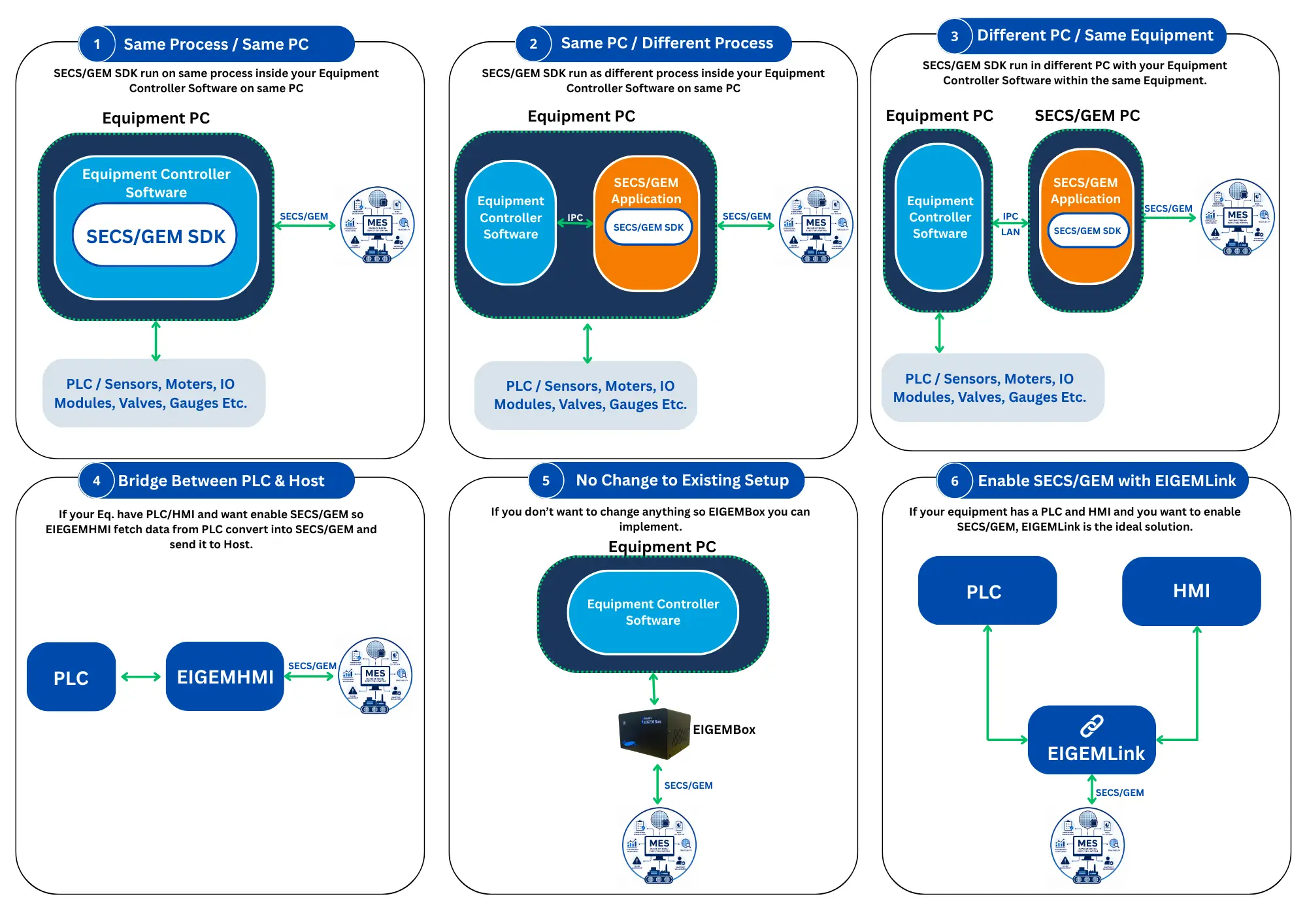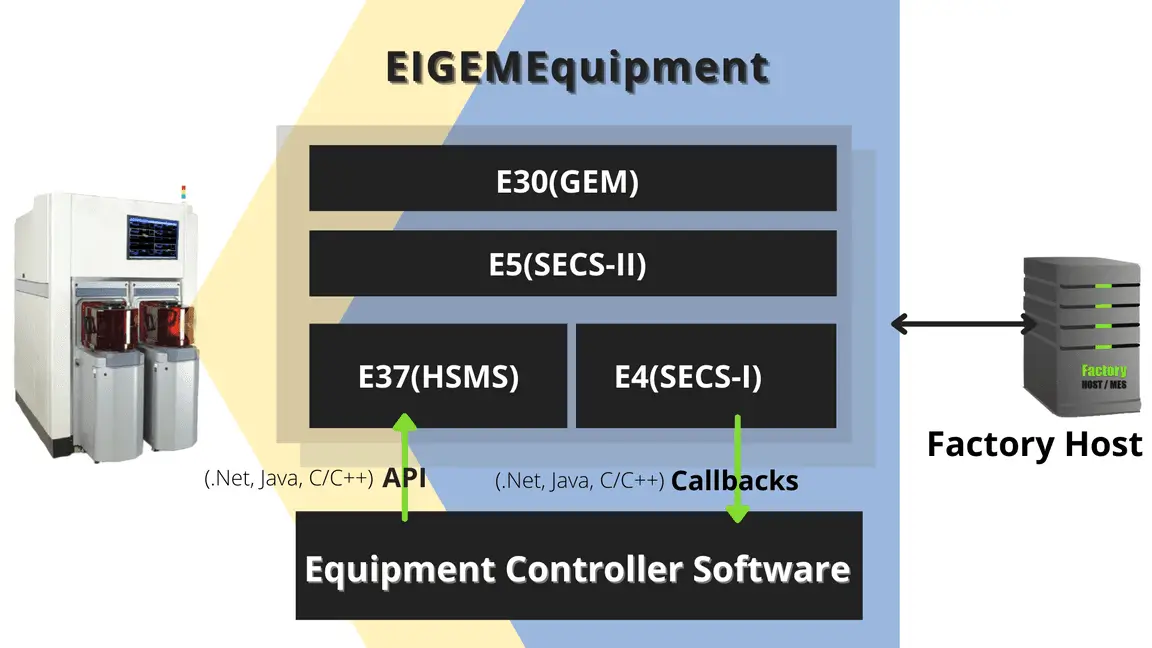
Fully SEMI E30, E4, E5, & E37 complaint.

80% of functionality available out of the box, no integration needed.

Cuts integration time by up to 20%.

REST API based separate executable option available.

No protocol expertise required – build SECS/GEM functionality without deep domain knowledge.

Supports all major programming languages – flexible integration with any system.

Simple, English-like APIs – easy to understand, learn, and implement quickly.

Accelerates SECS/GEM implementation significantly.

SECS/GEM Solution for FAB and ATPs

EIGEMEquipment is a SEMI standards-compliant SECS/GEM SDK and Implementation solution that simplifies equipment communication for semiconductor manufacturers. It provides a reliable foundation for implementing SECS/GEM without building communication logic from scratch, ensuring stable and seamless host connectivity.

Developed by eInnoSys, it is a powerful SECS/GEM solution for fabs and ATPs, supporting multiple programming languages and operating systems. The SDK reduces development effort, shortens implementation timelines, lowers costs, and ensures full compliance with SEMI standards, including GEM300 capabilities.

EIGEMEquipment

Customer Value

Faster SECS/GEM Implementation

Accelerate Implementation with a ready-to-use SDK for faster deployment and reduced development effort.

Lightweight SDK

High-performance, lightweight SDK with minimal resource usage and easy deployment.

Time Is Money

EIGEMEquipment speeds up development with ready-made SECS/GEM blocks, reducing effort and accelerating production readiness.

Efficient

Lightweight and CPU-efficient, it uses minimal system resources while maintaining stable performance on embedded and industrial platforms.

Future-Ready

Includes full SECS/GEM features with expandable GEM 200 capabilities, allowing upgrades without changing core communication logic.

Why Choose EIGEMEquipment SESC/GEM SDK?

Accelerated Time-to-Market

Eliminates months of low-level SECS/GEM development, allowing teams to focus on equipment features and deliver faster while aligning with SEMI standards.

Accelerated Time-to-Market

Assured SEMI Compliance

Implements required SEMI behaviours and message patterns with full GEM 200 support, reducing compliance risk and simplifying verification.

Assured SEMI Compliance

Reduced Engineering Cost

Minimises custom protocol coding, lowers debugging effort, and reduces total cost of ownership through reusable SDK components.

Reduced Engineering Cost

Enhanced Interoperability

Minimises custom protocol coding, lowers debugging effort, and reduces total cost of ownership through reusable SDK components.

Enhanced Interoperability

Proven Industry Expertise

Backed by Einnosys’ semiconductor automation experience, delivering robust SECS/GEM Implementation with predictable, production-ready performance.

Proven Industry Expertise

SECS/GEM SDK Benefits

Accelerated Development

Eliminate 3-6 months of SECS/GEM protocol development effort, allowing teams to focus on equipment functionality and competitive differentiation.

Lower Risk

Proven implementation reduces integration failures, host acceptance issues, and post-deployment communication problems that plague custom developments.

Cost Efficiency

Save $50K-$100K+ in engineering costs per equipment model by leveraging reusable SECS/GEM SDK components and reducing debugging cycles.

Scalability

Single SDK investment supports multiple equipment models, platforms, and generations, maximising ROI across product portfolios.

Expert Support

Access Einnosys integration expertise, avoiding common pitfalls and benefiting from decades of SECS/GEM implementation experience.

Supported SEMI Standards

SEMI E30 (GEM)

Specification for the Generic Model for Communications and Control of Manufacturing Equipment (GEM)

SEMI E4 (SECS-I)

Specification for SEMI Equipment Communications Standard 1 Message Transfer (SECS-I)

SEMI E5 (SECS-II)

Specification for SEMI Equipment Communications Standard 2 Message Content (SECS-II)

SEMI E37

Specification for High-Speed SECS Message Services (HSMS) Generic Services

SEMI E95

Specification for Human Interface for Semiconductor Manufacturing Equipment

Case Studies

Schedule a Technical Consultation

Connect with our experts to discuss your OEM and FAB/ATP requirements and explore the right solution for your operations.

    Related Products and Services

    Frequently Asked Questions.

    What is EIGEMEquipment?

    EIGEMEquipment is a software solution that facilitates SECS/GEM communication for semiconductor equipment, ensuring efficient data exchange and control.

    How does EIGEMEquipment improve manufacturing processes?

    EIGEMEquipment improves processes by enabling real-time monitoring and control, leading to higher efficiency and reduced errors.

    Can EIGEMEquipment be used with existing factory systems?

    Yes, EIGEMEquipment is designed to integrate seamlessly with existing factory systems and equipment.

    What are the main features of EIGEMEquipment?

    Features include robust SECS/GEM communication, easy integration, and comprehensive data collection and analysis tools.

    How do I get support for EIGEMEquipment?

    Support is available through our customer service team, who can assist with installation, configuration, and troubleshooting.

    How does SECS/GEM work?

    SECS (SEMI Equipment Communication Standard) and GEM (Generic Equipment Model) are communication protocols used to enable automation systems in the semiconductor and related industries. SECS is the physical and data link layer that defines how the equipment communicates with the factory control systems. GEM is a set of standard protocols and models that define how equipment in semiconductor manufacturing should be automated and controlled. Together, SECS/GEM allows for standardized communication between equipment and host systems for process control, data exchange, and reporting.

    Who maintains SECS/GEM?

    SECS/GEM is maintained by SEMI (Semiconductor Equipment and Materials International), a global industry association that develops standards for the semiconductor industry. SEMI works with industry professionals to ensure that SECS/GEM protocols stay up to date with technology advancements and industry needs.

    Where is SECS/GEM used?

    SECS/GEM is primarily used in semiconductor manufacturing but is also applicable in other industries such as flat panel display (FPD) manufacturing, photovoltaics, and related automated production environments. It’s used in environments where machines (equipment) need to communicate with host systems for data collection, process control, status reporting, recipe management, and more.

    What is SECS GEM Process Program?

    The SECS GEM Process Program refers to a software layer or interface that connects the equipment to the host system in a semiconductor or other manufacturing setup. It consists of a set of rules and standards (as part of GEM) that define how the equipment should respond to commands from the host, send data, report status, and manage alarms. The Process Program ensures that the equipment behaves as expected and communicates efficiently with other systems in the production environment.

    How to send commands to equipment using SECS/GEM?

    Use the GEM interface to issue S2F41 (Remote Command) messages to the equipment. This message includes the command name and parameters required for the equipment to execute the desired operation.

    What is HSMS in SECS/GEM?

    HSMS (High-Speed SECS Message Services) is a protocol for transmitting SECS messages over TCP/IP networks. It is faster and more efficient than SECS-I, which relies on RS-232 serial communication.

    What is an event in SECS/GEM?

    An event is a significant occurrence in equipment, such as a process step completion or error detection. It is configured in the GEM interface to trigger event reports, which notify the host system.

    What are SECS/GEM message types?

    Common message types include:

    • S1F1/S1F2: Equipment Status Requests and responses.
    • S2F13/S2F14: Data Collection Plan definitions.
    • S5F1/S5F2: Alarm reports.
    • S2F41/S2F42: Remote Commands and responses.

    How to handle multiple equipment with SECS/GEM?

    You can manage multiple equipment by:

    Ensuring each piece of equipment has a unique ID.
    Using a centralized host system capable of handling simultaneous SECS/GEM connections.
    Configuring communication channels (e.g., separate TCP/IP ports for HSMS).

    How to ensure SECS/GEM compliance?

    Follow these steps:

    • Use SECS/GEM standards (SEMI E30, E37, E4) during implementation.
    • Test using SECS/GEM compliance tools or simulators.
    • Verify compatibility with the host system.

    What are some SECS/GEM use cases?

    • Data Collection: Monitoring production metrics such as temperature or pressure.
    • Alarm Handling: Notifying operators of errors or warnings.
    • Recipe Management: Uploading or downloading recipes for process control.
    • Remote Control: Starting, pausing, or stopping equipment.

    How to troubleshoot SECS/GEM connectivity issues?

    Steps to troubleshoot:

    Check physical connections (cables, ports, network settings).
    Verify protocol configurations (RS-232 for SECS-I or TCP/IP for HSMS).
    Use SECS/GEM logging tools to analyze errors.
    Confirm that both host and equipment are properly configured for communication.

    How is SECS/GEM used in automation?

    SECS/GEM enables automated manufacturing by:

    • Sending commands from the host system to start or stop processes.
    • Automatically collecting and analyzing production data.
    • Synchronizing equipment operations in a factory.

    What are the benefits of SECS/GEM?

    Key benefits include:

    • Standardized communication across diverse equipment.
    • Improved manufacturing efficiency through automation.
    • Enhanced monitoring and control for better quality assurance.
    • Reduced downtime with real-time error detection.

    What is the difference between SECS-I and HSMS?

    SECS-I: Uses RS-232 serial communication, slower and suited for legacy systems.
    HSMS: Uses TCP/IP over Ethernet, faster and suitable for modern systems with higher data demands.

    SECS/GEM SDK
    Are your Looking for EIGEMEquipment?
    Contact us