
What is the SECS/GEM Communication Protocol?
SECS/GEM is the primary semiconductor equipment interface protocol used for equipment-to-host data communications. It is a combination of two distinct layers standardized by SEMI:
- SECS (Semiconductor Equipment Communication Standard): Handles the low-level message structures, syntax, and data transmission.
- GEM (Generic Equipment Model): Sits on top of SECS and defines the operational behavioral models, state machines, and automation rules for factory tools.
What is the SECS/GEM Protocol in Semiconductor Manufacturing?
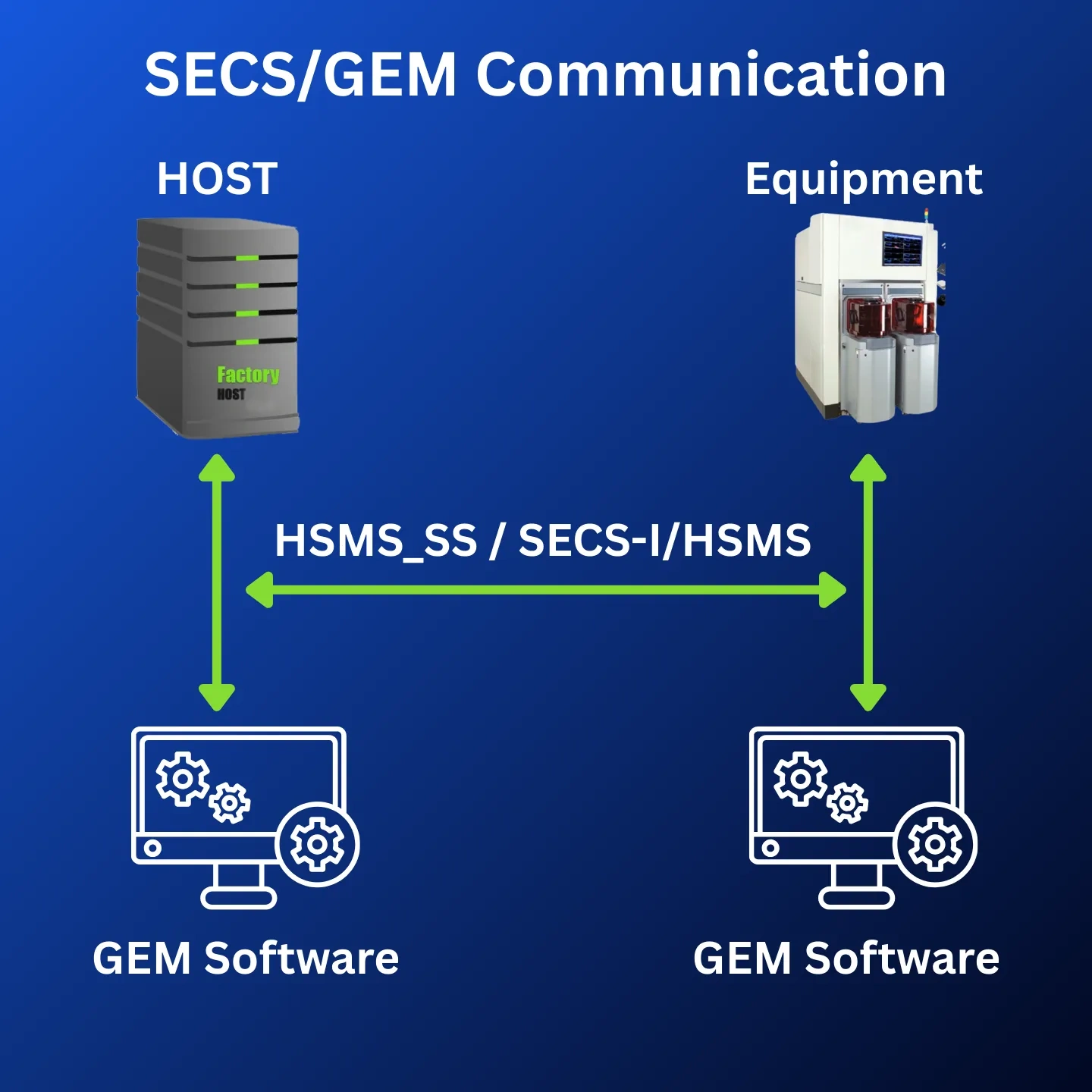
The SECS/GEM communication protocol is the global standard interface used for communication between semiconductor manufacturing equipment and a fab host or Manufacturing Execution System (MES). The fab host acts as the central software application that controls, tracks, and monitors equipment processing in real-time.
Connectivity and SEMI Standards Supported
With eInnoSys SECS/GEM compliant solutions, manufacturing equipment can seamlessly communicate with the fab host using two major communication modes:
- Network-Based (High-Speed): Uses TCP/IP networks via SEMI standards E37 and E37.1 (HSMS – High-Speed SECS Message Services).
- Serial-Based (Legacy): Uses RS-232 serial connections via SEMI standard E4 (SECS-I).
Key Use Cases of SECS/GEM Standard Interface
The protocol is strictly used to achieve full factory automation, including:
- Automated Control: Start, stop, and pause equipment processing automatically from the host.
- Real-Time Data Collection: Collect precise tool measurement data, process variables, and sensor outputs instantly.
- Recipe Management: Select specific product recipes, upload/download configurations, and safely change process parameters.
- Alarm and Event Handling: Send immediate alerts to the host if a tool encounters an error or requires maintenance.
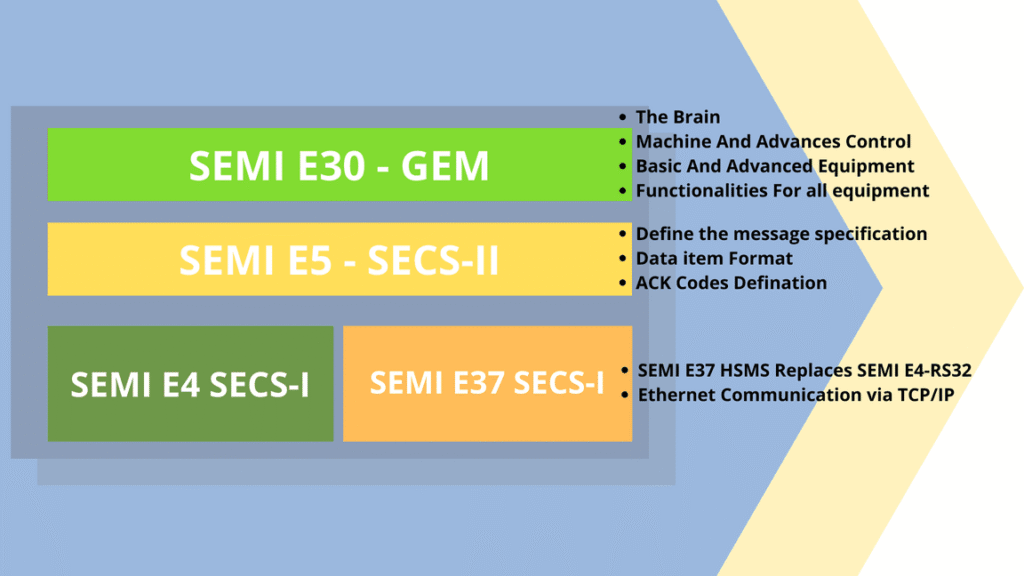


Key Components of SECS/GEM
SECS (SEMI Equipment Communication Standard)
- Defines the protocols and message formats for communication between host systems and equipment.
- Includes SECS-I (RS-232 based) and HSMS (High-Speed SECS Message Services, TCP/IP based).
GEM (Generic Equipment Model)
- Provides a standard way to control and monitor semiconductor manufacturing equipment.
- Defines a model for equipment behavior, status reporting, and data collection.
Applications of SECS/GEM
Semiconductor Manufacturing:
- Widely used in the semiconductor industry for wafer fabrication, testing, and packaging.
- Ensures precise control and monitoring of complex manufacturing processes.
Electronics Manufacturing:
- Applied in the production of electronic components and assemblies.
- Enhances the integration and automation of assembly lines.
Pharmaceutical and Biotech Industries:
- Used for equipment communication and control in the production of pharmaceuticals and biotechnology products.
- Ensures compliance with regulatory standards and quality control.
SECS/GEM Communication Diagram
Looking for a SECS/GEM Solution?
Whether you need to connect legacy equipment, develop SECS/GEM-enabled equipment, convert industrial protocols, test SECS/GEM communication, or implement GEM300, eInnoSys provides solutions for different semiconductor automation requirements.
Connect Legacy Equipment
Add SECS/GEM connectivity to existing or legacy semiconductor equipment without major equipment modification.
Product: EIGEMBox
Explore EIGEMBox →
Develop SECS/GEM Equipment
Build SECS/GEM-compliant equipment software faster with a ready-to-integrate SDK.
Product: SECS/GEM SDK
Explore SECS/GEM SDK →
Convert Industrial Protocols
Convert OPC, MQTT, Modbus, EtherCAT, Profinet and Ethernet protocols to SECS/GEM.
Product: EIGEMLink
Explore EIGEMLink →
Test SECS/GEM Communication
Simulate host and equipment communication and test SECS/GEM implementations before deployment.
Product: EIGEMSim
Explore EIGEMSim →
Implement GEM300 Automation
Implement advanced semiconductor equipment automation using GEM300 standards and solutions.
Product: GEM300 SDK / EIGEM300Host
Explore GEM300 Solutions →
Schedule a Live SECS/GEM SDK Demo
See how our software SDK reduces your factory integration time by up to 60%.
SECS/GEM Communication Standards
SECS/GEM isn’t just one rule. Not even close. It’s more like a family of SEMI standards working together. Each one handles a different piece of the conversation between semiconductor equipment and factory systems.
Inside a semiconductor fab, machines constantly exchange information—status updates, process data, alarms, and commands. The SECS/GEM framework keeps that communication structured so equipment and host systems understand each other perfectly.
What is the role of SECS-I (SEMI E4) in legacy factory automation?
SECS-I is one of the original communication methods used in semiconductor manufacturing. It defines how equipment and host systems communicate over serial connections, usually RS-232.
- Message block structure: Transmitted in blocks with headers, data payloads, and error-checking bits.
- Transmission timing rules.
- Handshake procedures: The host acknowledges receipt before the next block is sent.
- Error detection mechanisms.
eInnoSys Integration: In modern smart factories, these older tools are seamlessly integrated using eInnoSys SECS-I to HSMS Gateways, allowing legacy serial machines to talk directly to modern Ethernet-based factory automation systems.
How does HSMS (SEMI E37) improve communication speed over TCP/IP?
HSMS stands for High-Speed SECS Message Services. Instead of slow serial connections, HSMS utilizes high-speed TCP/IP Ethernet networks. This provides significantly higher bandwidth, lower latency, and massive scalability.
HSMS introduces structured session management with defined states: NOT CONNECTED, CONNECTED, and SELECTED.
eInnoSys Integration: By implementing advanced HSMS solutions like EIGEMLink, equipment can exchange high-volume data packets over standard factory infrastructure with zero scalability bottlenecks.
What is GEM (SEMI E30) and how does it define equipment behavior?
While transport protocols move messages, GEM acts as the fundamental rulebook defining how the equipment behaves. It standardizes four main functional areas:
- Equipment State Models: Tracks status (OFFLINE, ONLINE LOCAL, ONLINE REMOTE).
- Event Reporting: Generates instant automated notifications for process events.
- Data Collection: Reports critical equipment variables back to the host.
- Alarm & Command Standardization: Executes remote commands like Start Process, Stop Process, and Reset Alarms.
How are SECS-II messages structured using Stream and Function (SEMI E5)?
Every message follows a strict taxonomy built around Stream (S) and Function (F) identifiers (SxFy):
- Stream (S): Broad message category (e.g., Alarms).
- Function (F): Specific technical operation.
The Communication Stack
| Framework Layer | Standard | Function |
|---|---|---|
| 1. Transport Layer | SECS-I (E4) / HSMS (E37) | Handles physical connection (Serial/Ethernet). |
| 2. Message Layout | SECS-II (E5) | Enforces data format/grammar (SxFy). |
| 3. Machine Behavior | GEM (E30) | Defines operational states & reporting logic. |
eInnoSys SECS/GEM Solutions, Integration & Training
As a global leader in semiconductor automation, eInnoSys provides end-to-end capabilities to help equipment manufacturers (OEMs) and semiconductor fabs achieve full compliance and seamless factory connectivity.
1. Industry-Proven SECS/GEM SDKs
Accelerate your deployment with our compliant, high-performance SECS/GEM SDK software. Designed for quick integration, our SDKs support advanced SEMI standards with minimal coding required from your internal team.
2. Custom Automation & Gateway Integration
We don’t just sell software; we deliver complete integration solutions. From connecting legacy RS-232 serial tools using SECS-I to HSMS Gateways, to building custom fab host architectures, our engineering team handles the entire technical implementation.
3. Professional Training & Certification
To ensure your team can successfully manage and maintain automation systems, we offer structured SECS/GEM corporate workshops, hands-on debugging sessions, and virtual classroom training tailored to your production goals.
Professional SECS/GEM Training and Certification
As a leader in semiconductor automation technology, eInnoSys provides comprehensive SECS/GEM Training programs designed for software developers, automation engineers, equipment manufacturers (OEMs), and fab managers. Whether you are looking to understand the fundamentals or master advanced implementation, our expert-led sessions cover everything you need.
Our Key Training Modules Include:
- SECS/GEM Fundamentals: Complete deep-dive into SEMI standards (E4, E5, E30, E37, and HSMS).
- Practical Implementation: Hands-on guidance on configuring SECS/GEM SDKs and software architecture.
- Advanced Message Structures: Mastering Stream and Function (SxFy) taxonomy and custom message mapping.
- Troubleshooting and Testing: Real-world scenarios for debugging equipment-to-host connectivity issues.
We offer flexible learning options, including on-site corporate training workshops and interactive virtual classroom sessions tailored to your company’s production goals.
Once completely deployed via an industry-verified package like the eInnoSys SECS/GEM SDK, hundreds of interconnected machines across a manufacturing facility can talk, report, and respond simultaneously.
Implementing SECS/GEM on your Equipment? 🛠️
Don’t let compliance slow down your deployment. Get industry-standard SDKs tailored for your machinery.
How do our SECS/GEM standard services help?
The eInnoSys automation platform simplifies compliance across all eight core capabilities defined by the GEM standard, ensuring seamless integration between equipment and factory host systems:
Defines the behavior of the equipment regarding the presence or absence of a communication link with the host, including how to establish or resume connections using standard S1F13/S1F14 messages. Using eInnoSys SECS/GEM Software, factory hosts execute a reliable, automated connection process.
The eInnoSys CONTROL state model specifies three fundamental degrees of host control that establish the host’s capacity to command the apparatus:
- OFFLINE: The operator manually runs the machine via the local console. The equipment blocks host commands and replies with an SxF0.
- LOCAL/ONLINE: The host is restricted to “read-only” data collection. It cannot alter equipment constants or initiate remote physical motion.
- ONLINE/REMOTE: The highest automation tier. The factory host has full permission to command the equipment via the eInnoSys software interface.
While process state models depend heavily on specific tool technologies and machine designs, the eInnoSys implementation layer ensures a standardized operational lifecycle tracking framework across varied equipment types.
Allows the factory host to instruct eInnoSys-enabled equipment to perform automated operations, such as START, STOP, PAUSE, and RESUME, mimicking physical operator actions directly through software.
Our system manages three critical data types for precision tracking:
- Status Variables (SV): Read-only global values updated dynamically during processing (e.g., cycle counters).
- Equipment Constants (EC): Read/write variables that allow the host to modify operating parameters using proper operational formulas.
- Data Variables (DV): Transient values captured only at the exact moment a specific processing event occurs.
Enables highly customized reporting configurations. With eInnoSys SDKs, factories can dynamically link specific variables to custom collection events, ensuring the host receives precise datasets without processing overhead.
Provides an out-of-the-box framework to generate full GEM Compliance Declarations, variable lists, and thorough SECS-II message maps, making factory audits straightforward.
Enables equipment to instantly alert the host whenever an anomaly or safety risk occurs or gets resolved. The eInnoSys alarm framework ensures immediate broadcast of warnings to protect personnel, hardware, and physical materials.
Which SECS/GEM Solution Do You Need?
Benefits of SECS/GEM Integration
Improved Equipment Performance
One of the primary benefits of SECS/GEM integration is the significant improvement in equipment performance. SECS/GEM allows for real-time monitoring and control of equipment, enabling quick adjustments to process parameters. This real-time capability ensures that equipment operates at optimal conditions, reducing downtime and improving overall efficiency.
Enhanced Data Collection and Analysis
SECS/GEM facilitates comprehensive data collection from various equipment components. This data can be analyzed to identify trends, predict equipment failures, and optimize maintenance schedules. By leveraging the power of data analytics, manufacturers can make informed decisions, improve process quality, and reduce operational costs.
Increased Automation and Efficiency
Automation is a key driver of efficiency in manufacturing. SECS/GEM integration enables greater automation by allowing equipment to communicate seamlessly with factory control systems. This integration supports automated recipe management, equipment diagnostics, and process control, leading to reduced manual intervention, faster production cycles, and higher throughput.
Improved Equipment Utilization
With SECS/GEM, manufacturers can monitor equipment utilization in real-time, identifying underutilized assets and optimizing production schedules. This capability ensures that all equipment is used to its fullest potential, maximizing return on investment and minimizing idle time.
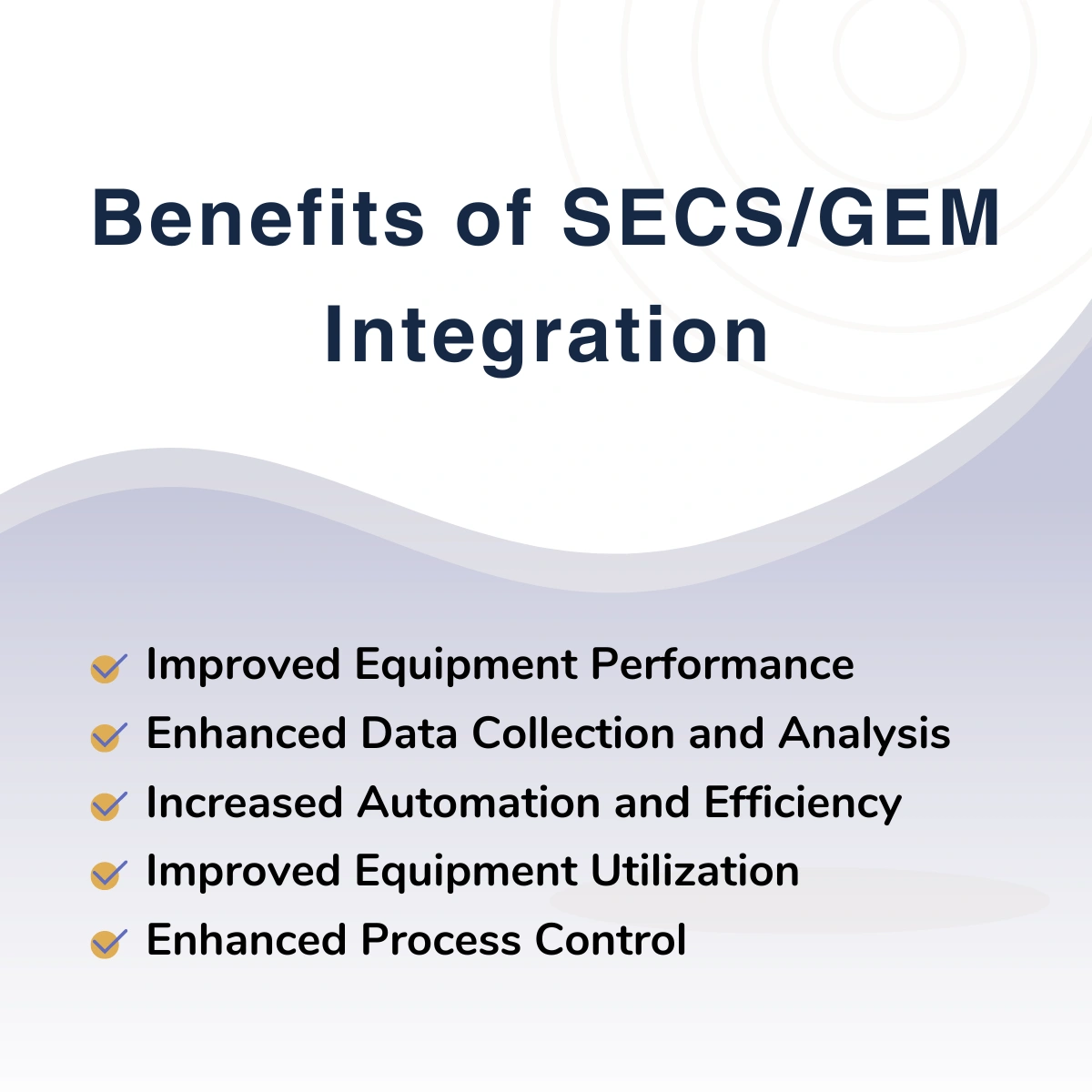
Enhanced Process Control
SECS/GEM provides granular control over manufacturing processes. Operators can remotely adjust process parameters, initiate diagnostics, and perform maintenance tasks without physically interacting with the equipment. This level of control enhances process stability, reduces variability, and improves product quality.
Latest SECS/GEM Standards & Smart Factory Implementation (2026 Update)
As semiconductor manufacturing scales toward smaller nodes and advanced packaging architectures (like OSAT/ATMP chiplet integration), equipment communication standards must support higher data throughput and zero-latency automation. Implementing robust SECS/GEM and GEM300 compliance ensures seamless host-to-tool connectivity across modern Smart Factories.
Key GEM300 Standards for Advanced Factory Automation
To achieve full high-volume manufacturing (HVM) compliance in 300mm wafer fabs, equipment must integrate the core components of the GEM300 standard suite:
- SEMI E87 (Carrier Management System): Governs how the host tracking system manages carrier IDs, capacity, and slot maps at the load port.
- SEMI E90 (Substrate Tracking): Enables real-time tracking of individual wafers or substrates as they move through internal process modules and chambers.
- SEMI E94 (Control Job Management): Manages the processing sequence of substrates within one or more carriers, optimizing recipe execution.
- SEMI E84 (Carrier Transfer): Optimizes the physical handshaking between Automated Guided Vehicles (AGVs), Overhead Hoist Transport (OHT), and the equipment load port.
Technical Data Flow: Host-to-Equipment Architecture
To implement standard SECS/GEM messaging, communication follows a layered structure from the physical hardware up to the Factory Host (MES):
Technical Data Flow: Host-to-Equipment Architecture
+-------------------------------------------------------------+
|             Factory Host / MES (Manufacturing Execution)     |
+-------------------------------------------------------------+
                              ^
                              |  SECS-II Messages (Stream / Functions)
                              v
+-------------------------------------------------------------+
|    HSMS Protocol (SEMI E37) over TCP/IP  /  SECS-I (E4)     |
+-------------------------------------------------------------+
                              ^
                              |  High-Speed Message Handshaking
                              v
+-------------------------------------------------------------+
|          Equipment SECS/GEM SDK / Automation Software       |
+-------------------------------------------------------------+
                              ^
                              |  Internal Drivers / APIs
                              v
+-------------------------------------------------------------+
|          Semiconductor Tool / Hardware PLC Control          |
+-------------------------------------------------------------+
How to Implement SECS/GEM Integration
Assessing Your Current Systems
Before implementing SECS/GEM, it is essential to assess your current manufacturing systems and equipment. Identify which equipment supports SECS/GEM protocols and determine the extent of integration required. This assessment will help you plan the implementation process effectively.
Choosing the Right SECS/GEM Solution
There are various SECS/GEM solutions available in the market, ranging from software libraries to complete integration platforms. Choose a solution that aligns with your specific requirements, budget, and existing infrastructure. Consider factors such as ease of integration, scalability, and support for future upgrades.
Testing and Validation
Once the integration is complete, conduct thorough testing to ensure that the SECS/GEM implementation is functioning as expected. Validate the communication between equipment and host systems, and verify that data exchange is accurate and reliable. Address any issues promptly to avoid disruptions in production.
Planning the Integration Process
Successful SECS/GEM integration requires careful planning and execution. Develop a detailed integration plan outlining the steps, timelines, and resources needed. Ensure that your team is trained on SECS/GEM protocols and familiar with the chosen solution. Collaboration with equipment vendors and SECS/GEM experts can also facilitate a smooth integration process.
Continuous Monitoring and Improvement
SECS/GEM integration is not a one-time task. Continuous monitoring and improvement are essential to maintain optimal performance. Regularly review equipment data, identify areas for improvement, and update your SECS/GEM implementation as needed. Staying proactive will help you reap the long-term benefits of SECS/GEM integration.
Related Products and Services

SECS/GEM Compliance SDK – Free Trial
Frequently Asked Questions (FAQs)
What is SECS/GEM protocol in semiconductor manufacturing?
The SECS/GEM protocol is a standardized communication framework that allows semiconductor manufacturing equipment to exchange data with factory host systems like MES. eInnoSys provides industry-certified SECS/GEM compliant software to streamline real-time data collection, equipment tracking, and full tool automation across production environments.
What does SECS/GEM stand for?
SECS stands for SEMI Equipment Communication Standard, and GEM stands for Generic Equipment Model. Together, they define how tools talk to factory hosts. Industry-proven solutions like the eInnoSys SECS/GEM SDK implement these standard messages and operational behavior models out of the box, saving years of custom coding.
What is the difference between SECS and GEM?
SECS (specifically SECS-I and HSMS) defines the core data transport protocol and packet message format, while GEM defines the equipment baseline behavior and state machine logic. Integrated architectures like the eInnoSys SECS/GEM SDK wrap both protocol layers into a unified developer interface for faster deployment.
What is HSMS in SECS/GEM communication?
HSMS (High-Speed SECS Message Services), defined in SEMI E37, is a high-speed communication protocol that runs SECS messages over TCP/IP Ethernet networks. Solutions like eInnoSys EIGEMLink leverage HSMS to deliver higher bandwidth, lower latency, and massive scalability compared to legacy serial connections.
What is the role of the GEM CONTROL State Model?
The GEM Control model dictates the depth of authorization a factory host has over a specific tool. The eInnoSys CONTROL state model structures this into three distinct tiers: OFFLINE (local manual operation), ONLINE LOCAL (read-only data collection by host), and ONLINE REMOTE (full remote host automation and control).
What types of equipment use SECS/GEM solutions?
SECS/GEM is globally utilized by lithography tools, etchers, deposition systems, and inspection machinery. For older tools or PLC-based hardware lacking native compliance, eInnoSys provides specialized SECS/GEM Gateway Solutions and EIGEM-HMI modules to enable automation without changing core hardware.
What are the core GEM300 standards required for 300mm wafer automation?
Modern 300mm wafer fabs require an advanced suite of standards for high-volume automation. The eInnoSys GEM300 SDK integrates these natively, including SEMI E87 for carrier management, SEMI E90 for substrate tracking, SEMI E94 for control jobs, and SEMI E84 for physical AGV/OHT transport handshaking.
How does SECS/GEM integrate with Kepware OPC and OSAT environments?
While Kepware OPC Server handles generic industrial PLC tagging, it lacks native semiconductor state models. eInnoSys software solutions bridge this gap by seamlessly integrating Kepware architectures with full SECS/GEM compliance, enabling advanced OSAT (Outsourced Semiconductor Assembly & Test) facilities to achieve zero-latency smart factory automation.