
Centralized Recipe Management for Semiconductor Manufacturing

Prevents wrong recipe execution – protect yield and avoid costly errors.

Centralized recipe control across all tools – ensure consistency fab-wide.

Full traceability and audit logs – simplify compliance and quality checks.

Reduces operator dependency – eliminate manual selection risks.

Cuts scrap and rework – improve overall production efficiency.

Standardizes processes – maintain uniform execution across shifts and sites.
Recipe Management System for Semiconductor Fabs & ATM / OSAT
EIRMS is a comprehensive manufacturing recipe management software that helps fabs and ATM facilities improve yield, engineering efficiency, OEE, and cycle time.
It enables complete control of equipment recipes, including version management, golden recipe support, and traceability of every change. EIRMS seamlessly integrates with SECS/GEM-capable equipment and can be customized for non-SECS/GEM tools, ensuring consistent recipe execution and compliance across all production lines.
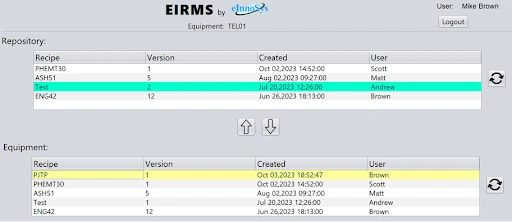
Recipe Management System (EIRMS) Workflow
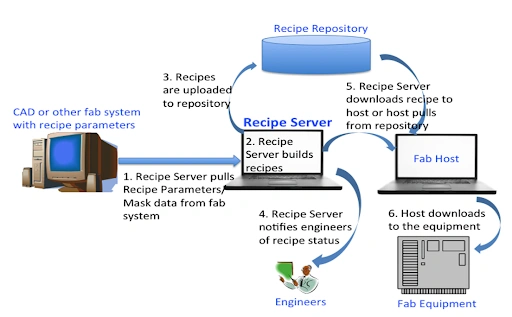
System Integration
EIRMS integrates seamlessly with:
- SECS/GEM-capable equipment
- Factory Host Systems
- MES Environments
- Centralized production control platforms
Custom solutions are available for non-SECS/GEM tools to ensure full flexibility.
Supported Toolsets
EIRMS supports various semiconductor toolsets, including:
- Canon i5+, i5 and i4 steppers
- Matrix System One dry etch
- SPEC wet bench
- IVS overlay metrology
- Ultratech wafer measurement
Deployment
EIRMS supports:
- SECS/GEM communication
- Centralized recipe server
- Version control management
- Enterprise-level operations
Scalable for small and large facilities.
| Feature | Manual | EIRMS |
|---|---|---|
| Version Control | ❌ | ✅ |
| Approval Workflow | ❌ | ✅ |
| Audit Trail | ❌ | ✅ |
| SECS/GEM Integration | ❌ | ✅ |
| Central Repository | ❌ | ✅ |
| Multi Tool Support | ❌ | ✅ |
Why Choose Einnosys?
EIRMS is developed by Einnosys, a semiconductor automation and software specialist with expertise in:
- SECS/GEM Integration
- Factory Automation
- Smart Manufacturing Solutions
- Advanced Manufacturing Systems
Einnosys delivers reliable and scalable Semiconductor Recipe Management Software solutions tailored for fab and ATM environments.
Use Cases & Applications
Semiconductor Manufacturing
Connect fab equipment to MES systems, enable 200mm/300mm compliance, and support advanced process control initiatives.

Smart Factory Integration
Bridge legacy equipment with modern Industry 4.0 platforms, IoT systems, and cloud-based analytics.

Manufacturing Execution Systems (MES)
Enable seamless data flow between shop floor equipment and enterprise MES platforms.

Industrial Automation
Integrate PLCs, SCADA systems, and industrial controllers with SECS/GEM host systems.

Multi-Vendor Environments
Create unified communication across equipment from different manufacturers using disparate protocols.

Cloud & Edge Computing
Connect industrial equipment to cloud platforms and edge computing infrastructure for advanced analytics.

Case Studies
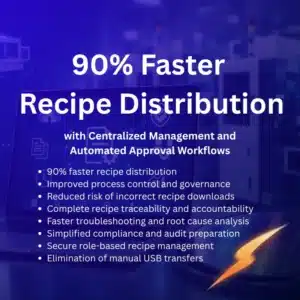
90% faster recipe distribution
Managing process recipes across multiple semiconductor manufacturing tools was becoming increasingly complex due to manual transfers, missing version…

Eliminating Human Error: Standardizing Recipe Management through Automated Version Control
Are your backend operations losing yield to manual data entry errors and recipe version mismatches? Discover how our…

How Historical Alarm Analytics Helped a Semiconductor Fab Eliminate Recurring CMP Process Alarms
A leading semiconductor fab struggled to validate recurring CMP process alarms because its legacy alarm system lacked historical…
Ready to Improve Yield, Engineering Efficiency & OEE?
Implement EIRMS – the centralized and compliant Recipe Management System for Semiconductor Fabs & ATM.
Whitepaper

AI/ML-Powered Predictive Analytics & Smart Fault Detection for Next-Gen Manufacturing
Unlock the future of smart factory automation with xPump, Einnosys’s AI/ML-based framework for predictive maintenance and smart Fault…

A Technical Overview of Automated Gauge Reading and Data Integration
A Technical Overview of Automated Gauge Reading and Data Integration
Related Products and Services
EIStationcontroller
EIStationController acts as a robust Station Controller Development Platform, enabling seamless communication…

Xpump
xPump – AI-based Predictive Maintenance System AI-powered real-time monitoring for pumps, motors,…
Frequently Asked Questions.
What is a Recipe Management System?
A Recipe Management System is a tool designed to manage, monitor, and ensure the accuracy of recipes used in semiconductor manufacturing. It helps fabs and ATM facilities (assembly, test, and packaging) improve yield, OEE (Overall Equipment Effectiveness), and engineering efficiencies.
How does a Recipe Management System improve yield and efficiency?
By ensuring that production lots always run with the correct version of the recipe, the system reduces errors, optimizes machine performance, and minimizes downtime.
Is the Recipe Management System compatible with all equipment?
Yes, it works with any equipment that has SECS/GEM capability. Custom solutions can also be developed for non-SECS/GEM-capable equipment.
What is SECS/GEM, and why is it important for Recipe Management Systems?
SECS (SEMI Equipment Communication Standard) and GEM (Generic Equipment Model) are protocols that enable seamless communication between manufacturing equipment and host systems. These protocols are essential for automation and efficient recipe management.
How does the Recipe Management System ensure recipe accuracy?
It verifies the recipe version against the production lot requirements and ensures the correct recipe is used at all times, reducing the risk of human error.
Can the system handle multiple equipment types in a fab?
Yes, the system is designed to support all equipment types, ensuring a centralized and streamlined recipe management process.
How does the system save engineering time?
By automating recipe updates, validations, and version control, the system saves weeks’ worth of engineering time annually that would otherwise be spent on manual adjustments and monitoring.
What data does the Recipe Management System collect?
RMS collects data like all recipes with particular version and modified date and User who uploaded or downloded version.
Can the system integrate with existing MES or factoryHost or StationController?
Yes, the Recipe Management System can be integrated with MES or factoryHost or StationController to ensure seamless operation and data flow across the manufacturing process.
Is the system scalable for large fabs or multi-site operations?
Absolutely. The system is designed to handle large-scale and multi-site operations, ensuring consistent recipe management across all locations.
What are the benefits of implementing a Recipe Management System?
Key benefits include improved yield, reduced cycle time, enhanced OEE, consistent recipe execution, reduced human error, and significant time savings for engineering teams.
How does the system handle recipe version control?
The system maintains a version history of all recipes and ensures that only the approved version is deployed during production, with updates tracked and recorded.
How is the Recipe Management System deployed?
Deployment involves integrating the system with the fab’s equipment and host systems, configuring recipes, and training operators and engineers on its use.
Can the system provide real-time monitoring?
Yes, it offers real-time monitoring of recipe execution and equipment status to ensure smooth operations.
What industries can benefit from a Recipe Management System?
It is primarily used in semiconductor manufacturing but can also benefit other industries requiring precise recipe or process control, such as pharmaceuticals and electronics assembly.